
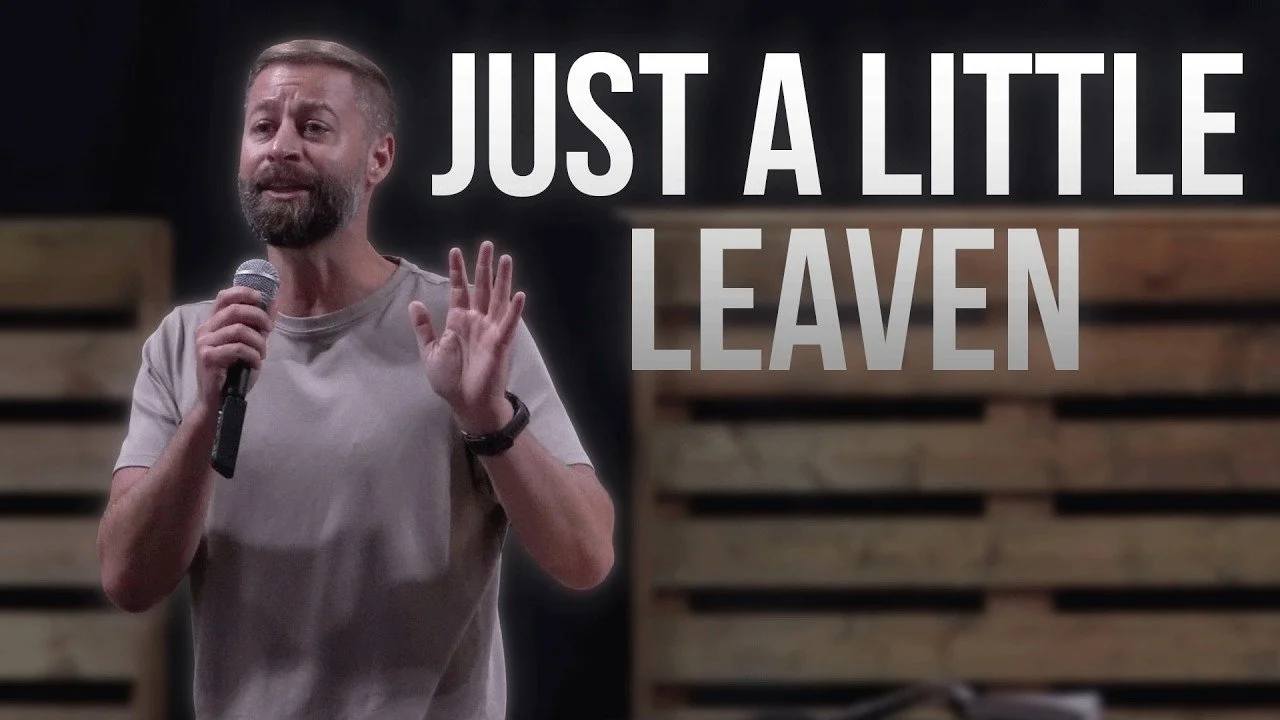
How One Small Addition to Christ Can Quietly Cost You Everything
Christian Freedom Series, Week 15
Big Idea: Any addition to Christ is not more allegiance but less; one small thing added to His finished work grows like leaven until a son is living as a slave, while a small faith in Christ alone grows until it makes a whole life unmistakably free.
Summary
Galatians 5:7–12 pictures a church that had been running well and came to a dead stop, not because it denied Christ but because it was persuaded to add one small requirement to Him. Preaching at The Grove Church in Port St. Lucie, Florida, David Hancock traces Paul's warning that a little leaven leavens the whole lump: a single addition to the work of Christ, however devout it sounds, grows until a person is striving under rules and unsure God loves him at all. Paul calls this desertion rather than devotion, because it declares that the King was not enough. The same principle runs the other way; a small faith in Christ alone will grow until Christ fills a whole life, and the offense of the cross, with the mockery it brings, is proof of belonging rather than a sign that something has gone wrong.
Key Takeaways
- When Paul says the Galatians were “hindered,” he uses a military word for a road deliberately torn up to stop an army; their faith was real and moving until someone broke the road on purpose.
- Being hindered from obeying the truth, not merely believing it, is the language of allegiance; adding anything to Christ as the way to freedom is pledging loyalty to another king.
- A little leaven leavens the whole lump: one small addition to Christ grows until a son is living like a slave, but a small faith in Christ alone grows until it makes a life unmistakably free.
- Paul's confidence was not in the Galatians but in the Lord, who carries what He began to completion; the Spirit of Christ is the leaven that finishes the work.
Read Galatians 5:7–12 (ESV)
You were running well. Who hindered you from obeying the truth? This persuasion is not from him who calls you. A little leaven leavens the whole lump. I have confidence in the Lord that you will take no other view, and the one who is troubling you will bear the penalty, whoever he is. But if I, brothers, still preach circumcision, why am I still being persecuted? In that case the offense of the cross has been removed. I wish those who unsettle you would emasculate themselves!
Talk about it
1. Think of a time someone convinced you to take on “just one more thing,” whether at work, at home, or at church, and it turned out to weigh far more than it looked. What made it so easy to say yes?
Running Well: What Does It Mean to Be Free in Christ?
Paul opens with a compliment that lands like a blow: “You were running well.” The picture comes from the Greek games, and Paul uses it across his letters for a life moving freely toward the finish. The Galatians had that. Their faith was not a false start; it was real. They had unyoked themselves from the law, which has no legs and cannot carry anyone anywhere, and had taken up the yoke of Christ, who does the pulling Himself. Paul has spent four chapters defining the freedom they were running in: the standing of a royal son of God, with an inheritance of land, people, and blessing that is given rather than earned.
That inheritance holds more than most people expect. It is God’s own presence, so that His love, joy, and peace grow inside a person the way a kingdom grows. It is a people who have your back rather than gossip behind it. It is freedom from guilt and shame, since there is now no condemnation for those in Christ. And it is a courtroom verdict that goes beyond “not guilty”: the Father looks at the Christian clothed in the righteousness of His Son and loves him with the same intensity He has for that Son. This is what the Galatians had, and what they were about to hand back.
Talk about it
2. The freedom Paul describes is the standing of a son who has already been handed the inheritance. Which piece of it do you find easiest to believe is yours, and which one do you quietly assume you still have to earn: the Father’s presence, His people, or His verdict over you? What would it take to stop earning it?
The Break in the Road: Why Is Adding to Christ the Same as Deserting Him?
After Paul left Galatia, traveling teachers arrived with a persuasive message. They did not tell anyone to deny Christ; they said that anyone who was really a Christian would also be circumcised and keep the law. It sounded like more devotion, not less. Circumcision had marked God’s people as God’s people for centuries, so the addition felt like completing what Christ began. Paul saw it differently. A few verses earlier he had said that anyone who takes it up is severed from Christ. The small addition led straight back to slavery.
KEY WORD: HINDERED
The word Paul uses in Galatians 5:7, translated hindered, means to cut in on. It was a military term for a road deliberately broken up so that an advancing army would be forced to stop. The picture is not of a runner growing tired but of a runner who was moving well until someone tore up the road in front of him on purpose.
Notice Paul’s exact words: they were hindered from obeying the truth, not merely from believing it. This is the language of allegiance, of holding fast to a king. To add anything to what Christ has done as a way of securing your freedom is to declare that your King was not enough, and that is desertion, however religious it looks. When Jesus said from the cross, “It is finished,” He meant it. Everything required for salvation was done. To try to earn what was finished is to look at the cross and say, “Thank you, but it wasn’t enough.”
Talk about it
3. The false teachers never said “deny Christ.” They said, “If you are really a Christian, you will also do this.” Where have you heard that sentence, from other people or from your own conscience, and what was the “this”? What has agreeing to it cost you?
A Little Leaven: What Does “A Little Leaven Leavens the Whole Lump” Mean?
Paul’s reasoning is a baker’s. Leaven does not stay where you put it; a pinch works through the whole loaf until every part is changed. One small addition to the work of Christ grows the same way. It begins as a pin on the chest, a little extra weight, and it ends with a person striving under rules, unsure he is saved, unsure God is pleased, unsure God loves him at all. A child’s illness becomes a punishment; a lost job becomes a verdict. A son ends up living like a slave, and the weight that started small is now unbearable.
KEY WORD: LEAVEN
Leaven is the rising agent in bread dough, in the ancient world usually a small piece of an older, fermented batch worked into the new one. Once mixed in it disappears, but given time it spreads through the entire lump and changes its nature. Scripture uses the image in both directions: for corruption that quietly spreads through a whole community (1 Corinthians 5:6), and for the kingdom of God growing in secret until it fills everything (Matthew 13:33).
Then Paul says the most provocative thing in the whole letter, wishing the teachers of circumcision would go all the way and cut everything off. The image of cutting runs through these verses: circumcision, a road cut apart, allegiance broken, the offense of the cross removed. Paul is following the logic to its end. A small devotion to the wrong master leads at last to self-destruction, and under the law, to being cut off from God Himself. But the same principle runs the other way. Jesus said the kingdom of heaven is like leaven a woman hid in flour until it was all leavened. A small faith in Christ alone will grow until Christ fills a whole life and makes it unmistakably free. That is why Paul’s confidence is not in the Galatians at all but in the Lord, who will carry what He began to completion.
Talk about it
4. Leaven does not announce itself; it just grows. When something goes wrong in your life, what is the first sentence you say to yourself about God? Is it closer to “He is punishing me” or “He is near”? What does that sentence reveal about what has been growing in you?
The Offense of the Cross: Why Does Loyalty to Christ Alone Bring Persecution?
Some had apparently claimed that Paul himself still preached circumcision when it suited him. His answer is simple: if that were true, why would anyone persecute him? The cross is offensive. It says that nothing you bring counts and everything you need has already been done for you. Preach that, and human pride is wounded; preach Christ plus something, and everyone can relax. Paul’s scars were his proof that he had never added anything. Lowered in a basket out of Damascus, stoned and left for dead at Lystra, beaten with rods at Philippi, mobbed at Thessalonica, lashed thirty-nine times on five separate occasions, held two years at Caesarea and two more at Rome, and by tradition beheaded under Nero, he paid for his allegiance to Christ alone with his body.
MATTHEW 5:11–12
“Blessed are you when others revile you and persecute you and utter all kinds of evil against you falsely on my account. Rejoice and be glad, for your reward is great in heaven, for so they persecuted the prophets who were before you.”
Jesus does not promise that allegiance to Him will be comfortable; He promises that the discomfort is a sign of belonging, and that the reward outlasts the mockery.
In America, no one is likely to experience persecution like Paul. But the world will still mock, question, and pressure anyone who refuses to add to Christ, and Paul wants his readers to read that pressure correctly. It is not evidence that something has gone wrong; it is evidence that you are a royal son or daughter waiting to attain what is already yours. One day those who mocked will hear the angels roar as the sons and daughters of God come home.
Talk about it
5. Paul says persecution was proof that he preached Christ alone; if he had added circumcision, the offense would have disappeared. Where have you softened the message of the cross to keep the peace with someone? What would it cost you to stop?
Four Breaks in the Road: What Are You Tempted to Add to Jesus Today?
These temptations never announce themselves as opposition to Christ. They sound like wisdom, safety, and completion; they sound like more allegiance rather than less, which is why they work. The sermon named four. The first is your moral resume: someone looks over what you have done and not done and implies you are not a real Christian, and the leaven grows until you are a joyless rule-follower. The second is political or tribal identity: someone asks for your voting record, and voting matters a great deal, but the moment your politics become proof of your freedom you are yoked to Jesus plus a party.
The third is deconstruction, a particular risk in this church: the suggestion that only those who have wrestled through doubt have a mature faith, until a person’s confidence rests on his story rather than on the Lord. The fourth is spiritual practices: journaling, early morning prayer, fasting, all good things, until the practices meant to reorient faith quietly become its object. Whenever you hear “Christ is Lord, but you also need,” that “but” is the break in the road.
THE PRACTICAL TEST
Listen for the word but. “Christ is Lord, but you also need to…” Whatever follows that but, whether a moral standard, a political position, a season of doubt, or a spiritual discipline, is the thing being offered as an addition to Christ. Good things can sit in that place as easily as bad ones. When you hear it, ask one question: what more can I do than Christ has already done?
Talk about it
6. Of the four breaks in the road, moral resume, political identity, deconstruction, or spiritual practices, which one has the strongest pull on you? Be specific about what you would add to Christ if you were honest. What does that addition give you that you are afraid faith in Christ alone will not?
The Heart of It: How Did Christ Finish the Race for You?
Christ ran the race you were made for and never stumbled. Every temptation became a hurdle He cleared, and before He reached the end He was mocked, stripped, whipped, and pierced. What kept Him running was the joy set before Him, and the joy was an inheritance. What could the Son inherit that He did not already have? Us. The Lord’s portion is His people, and He went all the way to the cross to get them. Inside death He became the leaven that grew until death could not contain Him. That same Spirit is now in you, the leaven that will finish what He started; your confidence is not in your running but in the Lord who will do it. And when the road breaks and you feel cut off from God, remember that He felt what it was like to be cut off for you, though never fully broken, so that when you feel far, you can trust He is still near. You have nothing to prove, except that you have nothing to prove.
Talk about it
7. Christ ran the whole race, finished it, and calls you His inheritance. If it is finished, what are you still trying to finish? What would change tomorrow if you believed the only thing you have to prove is that you have nothing to prove?
Questions This Sermon Answers
What does “a little leaven leavens the whole lump” mean in Galatians 5:9?
It means a small addition to Christ never stays small. Leaven is worked invisibly into dough and spreads until every part is changed. Adding even one requirement to the finished work of Christ, such as circumcision, grows until a person is striving under the whole law, unsure of God's love, living like a slave.
Why did Paul say the Galatians were hindered from obeying the truth?
The word hindered was a military term for a road deliberately broken up to stop an advancing army. Paul pictures believers running freely until false teachers tore up the road and persuaded them to add circumcision to Christ. He says obeying, not merely believing, because the issue is allegiance: adding to Christ is a quiet desertion to another king.
Is adding rules to faith in Jesus really that serious?
Paul says yes, because any addition declares that what Christ did was not enough. When Jesus said “It is finished,” everything required for salvation was accomplished. Trying to earn a finished gift rejects the gift itself. The false teachers never said to deny Christ; they said real Christians must also do more, and Paul calls that being severed from Christ.
What is the offense of the cross in Galatians 5:11?
The cross offends human pride because it says nothing a person brings counts and everything needed has already been done. If Paul still preached circumcision, no one would persecute him, since Christ plus effort lets pride survive. His beatings and imprisonments were proof of his allegiance to Christ alone, and mockery for that message is a sign of belonging to God.
What are modern ways people add to Christ?
Four are common: a moral resume used to judge who is a real Christian; political identity treated as proof of faith; deconstruction, where confidence rests on having wrestled through doubt rather than on the Lord; and spiritual practices such as journaling or fasting, good in themselves, that quietly become the object of faith. Each arrives as “Christ is Lord, but you also need.”
Vision for the Christian Life
The Christian life this passage envisions is not a cautious jog with one eye on the rulebook; it is a free run beside Christ toward a freedom that grows the whole way. It is a life that has learned to recognize the break in the road and the voice waiting there that seeks to add weight. When this happens, hand them the finished work of Christ. Sons and daughters who live this way still care about holiness, still vote, still doubt and pray and fast; they have simply stopped presenting any of it as proof. A little faith in Christ alone is enough; it will leaven everything. Keep running. He will bring you home.
Discussion Questions for Small Groups: Galatians 5
- Think of a time someone convinced you to take on “just one more thing,” whether at work, at home, or at church, and it turned out to weigh far more than it looked. What made it so easy to say yes?
- The freedom Paul describes is the standing of a son who has already been handed the inheritance. Which piece of it do you find easiest to believe is yours, and which one do you quietly assume you still have to earn: the Father’s presence, His people, or His verdict over you? What would it take to stop earning it?
- The false teachers never said “deny Christ.” They said, “If you are really a Christian, you will also do this.” Where have you heard that sentence, from other people or from your own conscience, and what was the “this”? What has agreeing to it cost you?
- Leaven does not announce itself; it just grows. When something goes wrong in your life, what is the first sentence you say to yourself about God? Is it closer to “He is punishing me” or “He is near”? What does that sentence reveal about what has been growing in you?
- Paul says persecution was proof that he preached Christ alone; if he had added circumcision, the offense would have disappeared. Where have you softened the message of the cross to keep the peace with someone? What would it cost you to stop?
- Of the four breaks in the road, moral resume, political identity, deconstruction, or spiritual practices, which one has the strongest pull on you? Be specific about what you would add to Christ if you were honest. What does that addition give you that you are afraid faith in Christ alone will not?
- Christ ran the whole race, finished it, and calls you His inheritance. If it is finished, what are you still trying to finish? What would change tomorrow if you believed the only thing you have to prove is that you have nothing to prove?
Related Messages in This Series
- Unmistakably Free: How to Find the Only Yoke That Sets You Free
- Spiritual Leaders: How to Know What Leaders to Trust
- From Slaves to Sons: How Rule Breakers and Rule Followers Are Both Slaves
Watch or listen anywhere: YouTube | Apple Podcasts | SoundCloud
Pastor David Hancock is the Lead Pastor of The Grove Church in Port St. Lucie, FL, a church where believers and skeptics wrestle honestly with faith and doubt.
Wrestling with a question this raised? You can text in your question on any Sunday and hear it answered after the sermon. Or come sit with people asking the same things. Plan Your Visit
Read the full sermon manuscript
Imagine you are running free on the race set before you. Nothing is slowing you down, you in the best shape of your life, the landscape is passing by you in a blur. But a break in your path stops you dead in your tracks. Someone approaches you and tries to persuade you to carry small pin on your chest as you run. Tt’s the right thing to do they insist, it’s the mark that you are one of the good ones. When you resist, the mocking and ridicule come. More people gather and apply great pressure to take the pin as you run. They show the morality of why you should be carrying it. You think what’s the big deal, fine. What we find today, is this small litter extra weight is the beginning of you becoming a slave. Today we learn to recognize the signs when the world is pressuring us to bend from the truth that set us free. We are in our series called Christianity Freedom from Paul’s letter to the Galatians, and today my aim is to equip you to remain allegiant to truth that sets you free no matter the pressure you find as you run in freedom.
“You were running well. Who hindered you from obeying the truth? This persuasion is not from him who calls you. A little leaven leavens the whole lump. I have confidence in the Lord that you will take no other view, and the one who is troubling you will bear the penalty, whoever he is. But if I, brothers, still preach circumcision, why am I still being persecuted? In that case the offense of the cross has been removed. I wish those who unsettle you would emasculate themselves!” (Galatians 5:7–12, ESV)
Paul opens with “you were running well.”
The image of running well comes from the Greek athletic games.
Paul uses this imagery repeatedly across his letters to churches.
Here Paul gives us an image of a man set free, running in freedom toward an even greater freedom.
Paul has been talking about this freedom the last 4 chapters and last week Paul brought us to the climax of his letter by saying for freedom Christ has set us free.
He uses a Hebraic idiom of intensification. In other words, he saying freedom over and over with highlights and exclamation points.
Paul then contrasts that freedom with the image of a slave yoked to the law.
A yoke is a wooden bar farmers use to lock two oxen together, so they can share the load and ensure they reach the destination.
Imagine yourself, yoked in. You look beside and see are yoked to the law.
You seek to move forward with the law, but it has no power to help you reach your destination; it counts for nothing, counts is a power word. The law has no legs, so it imprisons you where you stand.
Paul urges us to remove the yoke of the law. But we all yoke ourselves to something; we all rely on something. Jesus comes along and says in Matthew 11 my yoke is easy and my burden is light. Unyoke yourself to to the law, and yoke yourself to me, I’ll get you to freedom.
As soon as the Galatians did that, they were freed to run free with Christ bearing all the weight toward their complete freedom.
Now before we go further, let’s define what Christian freedom is from all that Paul has said leading up to these verses.
To be free to run free toward freedom means to be a royal son of God.
And specifically, what do sons receive that slaves don’t? A promised inheritance.
The inheritance Paul spoke of comes from God’s ancient promise of a land, people, and blessing.
The good land of Eden is in view, but something better that can never be lost again.
The good blessing of God’s very presence. God is love, joy, and peace itself. To have him is to have the divine version of it. But you don’t just hold it; it’s in you. The Spirit of the Son, when you yoke yourself to him, manifests in you. The kingdom of God grows in you because God is in you.
The good people are the people of God, where you are free from gossip, jealousy, and strife, and have people who have your back, reminding you and lifting you up into the joy, peace, and love that is found in God.
On top of this inheritance is freedom from guilt and shame. There is now no condemnation in Christ Jesus. You don’t have to pretend like sin isn’t a thing; like most are prone to do, you can boldly name it, knowing it has been cast as far as the east is from the west from your life.
Freedom is also standing in the courtroom and hearing not just not guilty, but hearing the judge praise you for your perfect record. The Christian is clothed with the righteousness of Christ. An alien righteousness given to them. Now the Father sees you like He sees His Son and looks at you with the same intensity of love that He has for His one and only son.
And you have the hope of a future righteousness. One day you will stand before God, at the gates of eternity, and be welcomed as a citizen of heaven, vindicated before your enemies, and the roars of the angel’s sound as you are welcomed in. There, in the moment, in a twinkling of an eye, you are changed to be the truest version of you, the you that you were always made to be.
The Galatians had this freedom. They ran in it.
Their faith wasn’t a false start, it was real and genuine.
Paul says, who hindered you from obeying the truth.
The word hindered means to cut in on. It’s a military term for a road deliberately broken to stop an advancing army.
Imagine you running beside Christ; nothing can stop you as you run free toward the future freedom promised. But then there is a break in the road; you stop, and when you do, a man meets you there and says, " Oh, look, you have a problem here; the road is broken, and he seeks to persuade you to go down another road, and add a small weight that he says will help you reach freedom.
One addition to yoke yourself to. Jesus plus this one thing he says is the way to freedom. You say, are you sure, and he is persuasive as vs. 8 says.
What is the addition Paul is talking about? A law, a pin, a mark. A small little thing that you must add to reach freedom.
Specifically, the addition was circumcision.
Okay, what’s going on here? After Paul left the region of Galatia, a group of traveling teachers, slithered in, and with forked tongues, persuaded the Galatians that Christ is great, but they must also follow the law and be circumcised.
That sounds strange to us, but it marked God’s people as God’s people.
Just add this one thing to what Christ did, mark yourself, and yoke yourself to it.
So those in Galatia put the yoke of this law around them with Christ.
The false teachers didn’t say deny Christ, they said, if you are really a Christian, you will do this thing. Like saying, come on, be the real deal.
Immediately, Paul says, in a few verses earlier, they became severed from Christ, cut off.
Now look at how Paul describes putting on this extra weight. As someone hindering you from obeying the truth?
He doesn’t say hindered from believing the truth, but from obeying it.
This is language of allegiance. Not simply believing something but being allegiant to it. Holding fast.
If you try to add to anything Christ has done as a way to gain your freedom, it’s like deserting and pledging your allegiance to another king.
They disguise it as more allegiance but it’s less, because it’s a statement that your King isn’t enough.
It’s like someone adopting you, and you rejecting it until you have earned the right to be adopted. But you can’t learn to be a son or daughter until you are one. Just the act of trying to earn being a son or daughter means you don’t understand the essence of being a son or daughter. You can’t earn sonship; you must be born into it by grace.
When Jesus said on the cross, “It is finished,” he meant it. All that was required for your salvation was accomplished; he did it all for us. That is the gift, and to try to earn it is to reject the gift of the death and resurrection of Christ.
That’s why it’s such a big deal.
It’s looking at all Christ did and saying, “Thanks, I appreciate it, but it wasn’t enough.”
And while the act seems small, Paul reasons it out like this: “A little leaven leavens the whole lump.”
We have a lot of bakers in our church. But for all of you who aren’t let me explain. He means that the same way when there is a little bit of leaven in bread, it grows until the whole loaf of lump of bread is full of leaven, so one small addition you add to the work of Christ, will grow until all you find yourself doing is striving under the law, the rules, striving to be good until you find yourself unsure you are saved, unsure you are right in God’s eyes, unsure he loves you.
It’s then you start saying things like “oh no, my kid got sick, God is doing this because I’m not keeping the rules. Oh no, I lost my job; God is doing this because I’m not doing enough good.”
The next thing you know, you don’t feel free at all. You are a son acting like a slave.
What started small became a weight that wouldn’t move. Slavery.
Paul says I wish those who did this to you would emasculate themselves.
Now, Paul is wild. This image of cutting runs through our verses. Circumcision, the cut or break in the road, the offense of the cross being removed, breaking allegiance, and now, he says the most provocative thing in this letter. I wish those who have been preaching circumcision would just cut the whole thing off.
Don’t ever say scripture is boring.
What is Paul getting at? He is speaking with intensity while following the logical flow of where one addition to Christ leads.
He is saying if you break your allegiance to Christ and pledge your allegiance to the law, then go ahead and go all in with the law, show how devoted to the law you are and cut everything off.
Here is the great reveal: A small devotion to the wrong master eventually leads to self-harm, self-destruction, and in the end, per OT law, cut off from God Himself.
Adding to Christ, empties you of Him and all the inheritance that comes with Him.
But just a small amount of faith in Christ alone will take over your whole life and make you unmistakably free.
Jesus, to help make this point, says in Matthew 13:33, “The kingdom of heaven is like leaven that a woman took and hid in three measures of flour, till it was all leavened.”
His point: a little bit of faith in Christ, a tiny bit, will grow into complete freedom and sonship.
Paul says I have confidence in the Lord that you will take no other view but mine.
Paul’s confidence is not in the Galatians; it’s in Christ the Lord.
He is displaying the same faith he is calling them to have.
He isn’t relying on his own persuasion, or his own skills, or goodness, but in the Lord.
He will bring it all to completion.
Paul’s message is this: Allegiance to Christ alone, even a small amount, will grow until Christ Himself grows in you and brings you, carries you into who you are made to be.
Allegiance to Christ the way Paul is talking, isn’t about showing your allegiance by your works of goodness, but by refusing to put your faith in anything but Him.
Christ alone not works will get you to the inheritance
Christ alone not works will get you to your land, your people.
Christ alone not works will get you to the blessings of the kingdom of love, joy, and peace.
Christ alone not works sets you free from guilt and shame.
Christ alone will get you to the day when you stand before God perfectly complete, lacking nothing, but standing with your people, as all of creation roars at the revealing of the sons of God in glory.
Christ alone will free you to run into this freedom. And works will follow. Not as a means of salvation, but proof of salvation.
If you haven’t begun running with Christ, today he stands beside you, offering you to take His yoke and run easy.
If you are already running with Christ, when the breaks in the road come, know they were put there on purpose. Someone is trying to steal your freedom; don’t hear them. Any addition to Christ is slavery.
If you are already running with Christ and you get stopped and start questioning if Christianity is really this good, when that happens, there will be persuasive people who seek to tell you to add to Christ. Don’t, that isn’t more allegiance but desertion.
Don’t submit to a yoke of slavery.
One little addition will grow and enslave you, and become a weight that holds you down, keeps you down, and cuts you off from the freedom you are made for.
But staying allegiant to Christ won’t be easy.
Paul says if he was still preaching circumcision, apparently people were claiming he was, when it was convenient, he says, why would I be persecuted? If I was preaching circumcision, the offense of the cross would be removed.
In other words, my persecution is proof I’m preaching Christ alone.
The cross is offensive. It’s a stumbling block and rock of offense.
And the offense of the cross will lead to persecution.
Now, in America, we are spoiled; no one is experiencing what Paul did for his allegiance to Christ.
In Damascus, he had to be lowered in a basket outside the city, because there was a plot to murder him.
In Jerusalem, his friends sent him away to save him because the Hellenists tried to kill him.
He was driven out of the whole district of Antioch.
In Iconium, there was a plot to stone him, so he fled.
In Lystra, he was stoned, dragged out of the city, and left for dead
In Philippi, he was stripped, beaten with rods, thrown into prison, with his feet fastened in stocks
In Thessalonica, a mob attacked the house he was staying in, and he fled by night
In Jerusalem again, he was seized by a mob in the temple, beaten, nearly killed
In Caesarea, he was held in custody for 2 years.
IN Rome he was under house arrest for 2 years awaiting trial.
He was lashed 5 different times, 39 lashes in a row, one lash shy of death.
Outside of the book of Acts, tradition says that he was imprisoned and executed under Nero, likely beheaded.
Will the offense of the cross bring this to you? Probably not.
But the world will pressure you, provoke you, question you, and mock you.
When they do this to you, it’s proof that you are a royal son or daughter of God waiting to fully attain what is already yours.
One day you will stand vindicated from all those who mocked you, ridiculed you, and persecuted you for your allegiance to Christ.
Jesus says when this happens, “Rejoice and be glad, for your reward is great in heaven.”
The mockers will see and hear the angels roar in celebration that the royal sons and daughters of God have come Home.
Until then we must watch out for anything we are tempted to add to what Christ did.
What are the breaks in the road and the temptations to change our allegiance?
Before we look at 4 of them you need to know this. These temptations never announce themselves as opposition to Christ; they sound like wisdom, safety, completion. They sound not like less allegiance but more; that is why it’s easy to fall for them. Let’s take 4 ways we experience that today.
1st Your moral resume: You are running well, you get stopped by a break in the road, and someone says, can you show me your moral resume? Someone looks at it and says, oh you did that? And you’ve never done this? Are you even Christian? Implying you aren’t a real Christian. Don’t fall for it. That leaven will grow until you are a joyless rule follower. Remind yourself of this: What more can I do than Christ has already done?
2nd is political or tribal identity. You’re running well, there is a break in the road someone set, and you stop. Someone appears and asks for your voting record. This is where you find real pressure from either direction, depending on the church you are in. Oh, you voted that way; how can you say you are a Christian if you voted like that? I’m not saying how you vote isn’t important; it’s incredibly important, but if you add your voting record as proof you are free, you have yoked yourself to Jesus plus politics. That leaven will grow until you are more allegiant to your political party than Christ.
3rd is deconstruction. You are running well, and there is a break; someone appears and asks, “When did you enter a period of doubt? Oh, didn’t you have that? You know only real Christians have wrestled through doubt. That’s what makes you more mature in your faith.” This is a risk in our church. A pride that we have faced our doubts and found faith after we faced them. That leaven will grow into a slavery to pride. Put your faith as Paul did in the Lord, not in your story.
4th is your spiritual practices. You stop at the break; someone appears and asks about your spiritual practices. They say, “Oh, you don’t journal, you don’t pray first thing in the morning, you don’t fast four times a year?” These aren’t bad things, but your faith is not in the practices. The practices are there to help reorient your faith.
Whenever you hear someone say “Christ is Lord, but you also need…” that but is the break in the road and the temptation to add something to Christ.
Christ already finished it and secured it all for you. You don’t have anything to prove, except that you have nothing to prove.
He said from the cross it is finished. He did what was required of you.
He ran the race, and every temptation became a hurdle he jumped over. He never stumbled.
He reached the finish line perfectly.
And before He reached the end, the perfect man was persecuted, mocked, stripped, whipped, and pierced.
What drove Him to keep running? The joy that was set before Him. For His joy He endured the cross, despising the shame. He ran with joy.
Not that he enjoyed the persecution and pain of the cross.
No, he ran through it to get to His inheritance.
What can Jesus inherit that He doesn’t already have? Us.
The Lord’s portion is his people, his allotted heritage. To purify for himself a people for his own possession.
He went all the way to the cross to get us.
And inside of death, He became the leaven in death that grew and overwhelmed death.
Death couldn’t hold him or contain Him.
His Spirit is now in you, the leaven that will finish what He started in you. Put your confidence in the Lord that He will do it.
And when you are running and start to doubt, remember this: He felt what it is like to be cut off, though never fully broken, so when we feel distant from God, when we get stopped by doubt, we can trust that though we feel far, God is still near.