
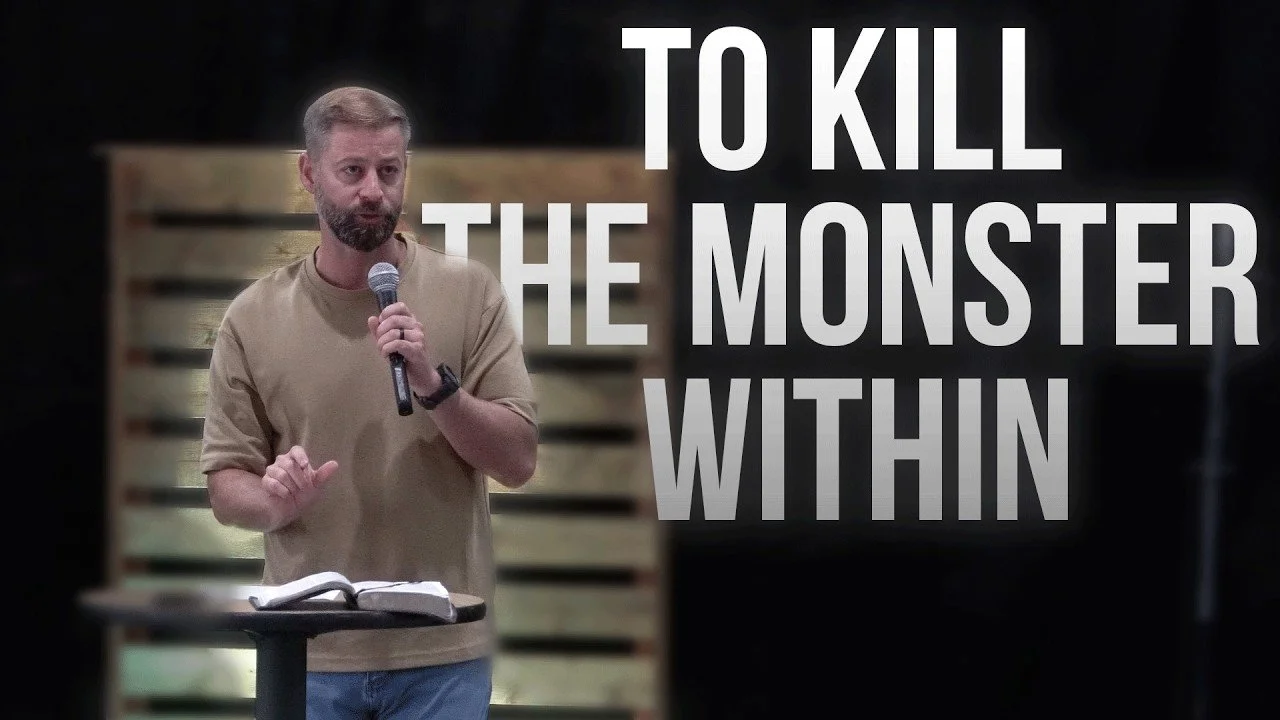
Why Fighting the Monster Within You Only Makes It Stronger
The flesh cannot be defeated by the flesh, so the only way to put the monster within to death is to stop relying on yourself and depend on the Spirit to animate the life of Christ in you.
Summary
Galatians 5:16–25 describes a war inside every Christian between the flesh and the Spirit, and names the fifteen works of the flesh alongside the nine-fold fruit of the Spirit. Preaching at The Grove Church in Port St. Lucie, Florida, David Hancock argues that Carl Jung was right that every person carries a shadow self, but that Paul goes further: the monster within cannot be defeated by self-reliance, because self-reliance is the very thing that feeds it. The only way to put the flesh to death is to walk by the Spirit, a disciplined, communal dependence on Him to bring the life of Christ to the surface. That life has already been won, since those who belong to Christ have crucified the flesh with Him at the cross.
Key Takeaways
- The flesh is not skin and muscle but the whole self living in reliance on itself, and Paul describes it as a living agent with desires that wage war against the Spirit.
- Fighting sin with your own strength does not shrink the monster; it feeds it, because the flesh is the monster and cannot be defeated by the flesh.
- Walking by the Spirit is a habitual, disciplined dependence on Him, pictured in Galatians 5:25 as soldiers keeping in step, and it is practiced together as a church.
- The command to bear the fruit of the Spirit is not a command to try harder but to stay attached to Christ, whose life the Spirit animates in the believer.
Read Galatians 5:16–25 (ESV)
But I say, walk by the Spirit, and you will not gratify the desires of the flesh. For the desires of the flesh are against the Spirit, and the desires of the Spirit are against the flesh, for these are opposed to each other, to keep you from doing the things you want to do. But if you are led by the Spirit, you are not under the law. Now the works of the flesh are evident: sexual immorality, impurity, sensuality, idolatry, sorcery, enmity, strife, jealousy, fits of anger, rivalries, dissensions, divisions, envy, drunkenness, orgies, and things like these. I warn you, as I warned you before, that those who do such things will not inherit the kingdom of God. But the fruit of the Spirit is love, joy, peace, patience, kindness, goodness, faithfulness, gentleness, self-control; against such things there is no law. And those who belong to Christ Jesus have crucified the flesh with its passions and desires. If we live by the Spirit, let us also keep in step with the Spirit.
Talk about it
1. Most people would call themselves basically good, and Carl Jung argued that every person carries a hidden shadow self. Which do you actually believe about yourself on an ordinary Tuesday? When did something come out of you that surprised even you?
The Monster Within: Why Does Fighting Sin Yourself Make It Worse?
Paul has shown that every person craves an inheritance, a land, a people, and a blessing, and that humanity’s default way of getting it is self-effort, whether by keeping the rules or breaking them. Here is the trouble. Paul speaks of the flesh as though it were alive, a shadowy creature with cravings of its own, at war with the Spirit inside every Christian. Self-reliance feels like the obvious weapon, but the flesh is the monster, and you cannot defeat the monster with the monster. Every time you rely on your own strength to master it, you hand it more claim over your life, and it grows.
KEY WORD: FLESH
Flesh translates the Greek word sarx. In Galatians Paul does not mean skin and muscle, nor the body as opposed to the soul. He means the whole person living in reliance on himself, cut off from the Spirit of God, whether that self-reliance looks religious or rebellious. That is why the flesh can have desires, wage war, and produce works: it is the old self at the controls.
THE SERMON’S ILLUSTRATION
In Robert Louis Stevenson’s story, Dr. Jekyll drinks a potion and becomes Mr. Hyde. Every time Hyde is let out he returns stronger and more violent, until Jekyll turns into Hyde with no potion at all. Self-reliance is the potion; every time a person drinks it, the monster grows.
Talk about it
2. Paul says the flesh cannot be defeated by the flesh; self-reliance is the potion that turns Jekyll into Hyde. Think of the sin you have fought longest. How much of that fight has been you trying harder, and over those years has the monster shrunk or grown?
Fifteen Faces: What Are the Works of the Flesh in Galatians 5?
Paul lists fifteen ways the monster shows itself when a person turns to self-reliance. Most won’t display all fifteen at once; everyone displays some. The largest group by far is relational, because a community of monsters is where self-reliance leads. A person wants the blessing, to love and be loved, to have joy and peace. When self-effort fails and he sees others who seem to have it, jealousy and envy break out, harden into division and rivalry, and he tears down whatever looks like what he wants but is not his; when that fails, he escapes, loses control, and tears himself apart. So who will save us from the monster within?
THE WORKS OF THE FLESH
Paul’s list in Galatians 5:19–21 moves in four groups: three sins of appetite turned inward (sexual immorality, impurity, sensuality); two sins of false worship (idolatry, sorcery); eight sins that break relationships (enmity, strife, jealousy, fits of anger, rivalries, dissensions, divisions, envy); and two sins of lost self-control (drunkenness, orgies). More than half the list is relational; self-reliance does its worst damage in community.
Talk about it
3. More than half of Paul’s list is about broken relationships, and the sermon said it begins when you see someone else enjoying the life you have been trying to earn. Whose life are you quietly envying right now, and what has that envy already done to how you speak about them?
Keep in Step: What Does It Mean to Walk by the Spirit?
Paul says there is hope. The monster is in the Christian, but so is the Spirit of the living God, and the command is not to fight harder but to walk by the Spirit: a habitual reliance on Him to animate the life of Christ in you. A life dependent on the self makes the monster grow; a life dependent on the Spirit makes Christ grow. In verse 25 Paul sharpens it to military language, a whole church keeping in step together, unity without uniformity. The result is fruit: love, joy, peace, patience, kindness, goodness, faithfulness, gentleness, and self-control. Jesus said He is the vine and apart from Him we can do nothing; fruit comes not from effort but from staying attached to the root.
KEY WORD: STOICHEO
Stoicheo, the Greek word translated keep in step in Galatians 5:25, was a military term for soldiers marching in rank, holding formation as a unit. It is more disciplined than the ordinary word for walking Paul used in verse 16. Paul pictures a church trained to depend on the Spirit the way a soldier is trained to hold his place in the line: not a mood, but a practiced, shared discipline.
Talk about it
4. Paul’s command is not to love harder but to walk by the Spirit, and the sermon called it a discipline, like a soldier holding formation. If someone watched your week, would they see a discipline of depending on the Spirit or an occasional emergency prayer?
Already Dead: What Does It Mean That the Flesh Has Been Crucified?
Every day the Christian chooses: depend on yourself or depend on the Spirit. Paul warns that those who live by the works of the flesh will not inherit the kingdom, and the sermon was careful here. A flash of jealousy does not cost anyone the kingdom; Paul describes a life defined by jealousy rather than love. The question is what your life is defined by, and, when the monster comes out, whether you try harder or depend on the Spirit more. That is the test. And the Christian’s role is not to kill the monster, because Christ already has. It is to refuse, absolutely, to depend on yourself. When life is hard, when you are jealous at work, when someone mistreats you, when your kids will not listen, when your spouse upsets you and you feel Mr. Hyde rising: depend on the Spirit to animate the life of Christ in you.
KEY WORD: CRUCIFIED
When Paul writes in Galatians 5:24 that those who belong to Christ “have crucified the flesh,” the Greek verb is in the aorist tense, which describes a completed action, already done rather than in progress. The Christian’s flesh was put to death when he was united to Christ at the cross. Paul still tells believers to put off the old self, but the order matters: you are not killing a living monster to become free; you are refusing to feed a dead one.
Talk about it
5. The sermon said the test is not whether the monster ever comes out but what you do next. Replay the last time it came out: what did you do in the following hour? Where are you still managing or negotiating with something Paul says is already dead?
The Heart of It: How Did Christ Put the Monster to Death?
Christ emptied Himself and came in the likeness of sinful flesh. On the cross He became sin who knew no sin; He wore the monster in us, took it from us, and claimed it as His own. When Christ was crucified, the monster within us was crucified with Him and buried with Him. When He rose, He left it in the grave, and everyone who clings to Him by faith is raised into that new life. You are no longer a slave to the monster but a royal son. Do not manage it; do not negotiate with it. It has no power over you. Walk by the Spirit, keep in step with the Spirit, and let the life of Christ be animated in you.
2 CORINTHIANS 5:21
“For our sake he made him to be sin who knew no sin, so that in him we might become the righteousness of God.”
This is the exchange at the center of the Christian faith. Christ took the monster that lived in us and wore it to the cross as His own, and in return the believer receives Christ’s own standing before God. The flesh was not reformed at Calvary; it was executed.
Talk about it
6. Christ took the monster that lived in you, wore it to the cross, and left it in the grave. Where are you still living as though it were alive and you were its slave? What would it look like this week to act like a royal son instead?
Questions This Sermon Answers
What does Paul mean by the flesh in Galatians 5?
Flesh translates the Greek word sarx. In Galatians Paul does not mean skin and muscle, nor the body as opposed to the soul. He means the whole person living in reliance on himself, cut off from the Spirit of God, whether that self-reliance looks religious or rebellious. That is why the flesh can have desires, wage war, and produce works: it is the old self at the controls.
What are the works of the flesh in Galatians 5:19–21?
Paul’s list moves in four groups: three sins of appetite turned inward (sexual immorality, impurity, sensuality); two sins of false worship (idolatry, sorcery); eight sins that break relationships (enmity, strife, jealousy, fits of anger, rivalries, dissensions, divisions, envy); and two sins of lost self-control (drunkenness, orgies). More than half the list is relational; self-reliance does its worst damage in community.
Why does fighting sin in your own strength make it worse?
Because the flesh is the monster, and the monster cannot be defeated by the monster. Every time a person relies on his own strength to master the flesh, he hands it more claim over his life and it grows, the way Dr. Jekyll’s potion made Mr. Hyde stronger with every dose. Self-reliance is the potion; the answer is dependence on the Spirit.
What does it mean to walk by the Spirit?
Walking by the Spirit is a lifestyle, a habitual reliance on the Spirit to animate the life of Christ in a person, rather than a single decision or a feeling. A life dependent on the self makes the flesh grow; a life dependent on the Spirit makes Christ grow, producing love, joy, peace, patience, kindness, goodness, faithfulness, gentleness, and self-control.
What does keep in step with the Spirit mean in Galatians 5:25?
Stoicheo, the Greek word translated keep in step in Galatians 5:25, was a military term for soldiers marching in rank, holding formation as a unit. It is more disciplined than the ordinary word for walking in verse 16. Paul pictures a church trained to depend on the Spirit the way a soldier is trained to hold his place in the line: not a mood, but a practiced, shared discipline.
What does it mean that Christians have crucified the flesh in Galatians 5:24?
The Greek verb in Galatians 5:24 is in the aorist tense, describing a completed action, something already done rather than in progress. The Christian’s flesh was put to death when he was united to Christ at the cross. Paul still tells believers to put off the old self, but you are not killing a living monster to become free; you are refusing to feed a dead one.
Does feeling jealous mean a Christian will not inherit the kingdom of God?
No. Paul warns that those who do such things will not inherit the kingdom, but he is describing a life defined by jealousy rather than love, not a passing flash of it. Every Christian still sins. The question is what a life is defined by, and whether, when the flesh shows itself, a person tries harder or depends on the Spirit more.
Vision for the Christian Life
The Christian life this passage envisions is not a lone believer white-knuckling his way past his worst impulses but a people so dependent on the Spirit that the life of Christ rises in them. Christ, the root of Eden, has dug Himself into our world, and by faith you and everyone who calls on His name are attached to Him, bearing fruit together until you become a grove of love, joy, peace, patience, kindness, goodness, faithfulness, gentleness, and self-control. The monster is dead. Keep in step with the Spirit, and let the life of Christ grow.
Discussion Questions for Small Groups: Galatians 5
- Most people would call themselves basically good, and Carl Jung argued that every person carries a hidden shadow self. Which do you actually believe about yourself on an ordinary Tuesday? When did something come out of you that surprised even you?
- Paul says the flesh cannot be defeated by the flesh; self-reliance is the potion that turns Jekyll into Hyde. Think of the sin you have fought longest. How much of that fight has been you trying harder, and over those years has the monster shrunk or grown?
- More than half of Paul’s list is about broken relationships, and the sermon said it begins when you see someone else enjoying the life you have been trying to earn. Whose life are you quietly envying right now, and what has that envy already done to how you speak about them?
- Paul’s command is not to love harder but to walk by the Spirit, and the sermon called it a discipline, like a soldier holding formation. If someone watched your week, would they see a discipline of depending on the Spirit or an occasional emergency prayer?
- The sermon said the test is not whether the monster ever comes out but what you do next. Replay the last time it came out: what did you do in the following hour? Where are you still managing or negotiating with something Paul says is already dead?
- Christ took the monster that lived in you, wore it to the cross, and left it in the grave. Where are you still living as though it were alive and you were its slave? What would it look like this week to act like a royal son instead?
Related Messages in This Series
- The War Within: Why Freedom Is Not a License to Sin but to Love
- Unmistakably Free: How to Find the Only Yoke That Sets You Free
- From Slaves to Sons: How Rule Breakers and Rule Followers Are Both Slaves
Watch or listen anywhere: YouTube | Apple Podcasts | SoundCloud
Pastor David Hancock is the Lead Pastor of The Grove Church in Port St. Lucie, FL, a church where believers and skeptics wrestle honestly with faith and doubt.
Wrestling with a question this raised? You can text in your question on any Sunday and hear it answered after the sermon. Or come sit with people asking the same things. Plan Your Visit
Read the full sermon manuscript
Most people, if you asked them, would say they are generally a good person. Some would even go further and say we are all naturally prone toward goodness, that people are basically good to the core. Carl Jung spent his life studying the human mind and came to an unsettling conclusion: Every one of us carries something dark inside, a shadow self. And if you pretend it’s not there, it only grows and erupts when you least expect it. Is Carl Jung right? Is there a shadowy monster in us all? Today we find Carl Jung was right; but it’s much worse. Not only is there a monster, but when you try to muster up your own strength to fight it, the monster within you grows until you can’t control it anymore.
We are in our series called Christian Freedom from Paul’s letter to the Galatians, and today we learn how to put the monster within to death.
16 But I say, walk by the Spirit, and you will not gratify the desires of the flesh. 17 For the desires of the flesh are against the Spirit, and the desires of the Spirit are against the flesh, for these are opposed to each other, to keep you from doing the things you want to do. 18 But if you are led by the Spirit, you are not under the law. 19 Now the works of the flesh are evident: sexual immorality, impurity, sensuality, 20 idolatry, sorcery, enmity, strife, jealousy, fits of anger, rivalries, dissensions, divisions, 21 envy, drunkenness, orgies, and things like these. I warn you, as I warned you before, that those who do such things will not inherit the kingdom of God. 22 But the fruit of the Spirit is love, joy, peace, patience, kindness, goodness, faithfulness, 23 gentleness, self-control; against such things there is no law. 24 And those who belong to Christ Jesus have crucified the flesh with its passions and desires. 25 If we live by the Spirit, let us also keep in step with the Spirit.
Through the series, we have seen that all of humanity craves, desires, and wants three things. A land, a people, and a blessing. Paul calls this an inheritance. God has put this hope in every man, woman, and child.
The Land is Eden. The far-off country we have never been to but somehow still remember. God has put eternity into the hearts of man that we might remember the land we are made for, the eternal land. Eden. But Paul talks of something better than Eden, an Eden that can’t be lost.
The people is a family united by something stronger than blood. People who build us up, have our backs. A people of hope, hope in a promise that unites as one through a blessing.
The Blessing. What is the blessing? Let me set the scene: Imagine a young boy at the beach standing at the edge of the water and he scoping water and pouring it into an overflowing bucket. You ask Him what he is doing and He says I’m putting the ocean in this bucket. You say I don’t think it will fit. He looks up at you with an intense wisdom and says, if the fullness of God can fit in man, than surely the ocean can fit in this bucket.
This is, what many have called the greatest blessing of Christianity. That by Faith in Christ the Spirit comes to dwell in us. The Christian doesn’t just find forgiveness but the fullness of the living God in Him. God is Love, joy, peace, patience, kindness, goodness, gentleness, self-control. And if the God who is these things is in you, then that fruit grows out of you.
So humanity, whether we know it or not, wants this land, people, and blessing. We seek it in all that we do. We strive for it through hard word, to find the place of heaven, nirvana, or paradise, we seek the people we can rely on, who love us, and we seek the blessing of the good and abundant life of joy, and peace.
Paul has pointed us back to the ancient promise given to Abraham that he was to go into the unknown and go to the land he will show him, and along the way He will become a father of many nations, and through him all the nations of the earth will be blessed.
Paul then showed us humanity’s default mode is to try and earn the land, people, and blessings through self effort.
We either create a law or follow God’s law and use that law to earn this inheritance.
We perform, work, and call it responsibility, or we escape, and run and call it fun and freedom.
Both are the same; each person gives themselves a law that they follow that they think will give them the good life. One follows the rules to get to the good life, another breaks the rules to get to the good. In both cases, the self is central to achieving the good life.
Both the religious and irreligious use self-reliance to find the good life.
Here is the problem with self-reliance. 16 But I say, walk by the Spirit, and you will not gratify the desires of the flesh. 17 For the desires of the flesh are against the Spirit, and the desires of the Spirit are against the flesh, for these are opposed to each other, to keep you from doing the things you want to do.
The flesh here is personified as a shadowy monster in you, alive and wanting to gratify its desires.
There is a war inside of you right now. And self-reliance feels like the obvious weapon to end it.
Paul asked earlier in the letter: “Having begun by the Spirit, are you now being perfected by the flesh?” (Gal 3:3).
The flesh is the monster. So you can’t defeat the monster with the monster.
All you are doing is giving it more claim over your life so it grows.
You are activating the monster by self-reliance.
If we ignore the monster, it grows; if we fight with our own strength, it activates and grows more.
In the story of Dr. Jekyll and Mr. Hyde
Dr. Henry Jekyll is a respected London physician, admired for his virtue and generosity. He was fascinated by the idea that every person is not truly one, but two, a civilized, respectable self and a hidden, indulgent self, kept under control.
He develops a potion that separates the two natures entirely, and by drinking it he transforms into Edward Hyde, a smaller, uglier, entirely amoral version of himself, free to indulge every appetite without risk to his reputation.
Hyde starts small and almost harmless, trampling a child in the street without remorse, paying the family off with money. But every time Hyde is activated, he becomes stronger, larger, more confident, more violent. Eventually Hyde brutally murders a Member of Parliament.
Horrified, Jekyll resolves never to become Hyde again. But one day, sitting on a bench, simply entertaining his old cravings in his mind, without taking any potion at all, he suddenly finds himself transformed into Hyde.
Certain of his permanent entrapment as Hyde, he takes his own life. His friends find him in the laboratory, Hyde's body on the floor, wearing Jekyll's clothes, and a fully written confession explaining everything.
What Paul describes is Dr. Jekyll and Mr. Hyde but inside of us. The flesh in us is a monster, and the more we try to master it, the larger and more powerful it becomes.
Paul’s argument is that when you rely on works of the law, and your own fleshy ability to follow the law, it’s like drinking the potion and the monster grows.
Self-reliance is the potion that activates the monster.
It’s terrifying. God gives us a beautiful law to follow. Something to aim at, but if we rely on ourselves to achieve the law, we bend into something hideous.
A person can sincerely try to do the right thing to earn the inheritance of the land, people, and blessing, and in doing so awaken the monster within.
Jung was right that there is a monster within us and it grows if we don’t admit it’s there and ignore it. Paul goes further and says and if we acknowledge it and fight it by our own efforts it only grows.
Paul then gives a list of 15 ways the monster expresses itself when we turn to self-reliance. Before I give you these, I want you to understand these aren’t all present at once, and the monster in us will express not all of these but some of them.
The 1st 3 are an inward turning on self and the appetite: sexuality, immorality, impurity, and sensuality.
The next two are false worship: idolatry and sorcery. Idolatry and sorcery are like using something other than God to get to the good life.
The next 8 are all relational breakdowns. This is Paul’s main focus here. A community of monsters is where self-reliance leads.
And the last two express a loss of self-control. Drunkenness and orgies. This, in a way, is trying to escape the reality that you don’t have the good life, so you use anything to escape the pain of not getting what you desire.
Now, Paul doesn’t say this, but I’d argue we don’t all express all of these when the monster comes out, but all of us express some of these when the monster comes out.
And these all happen because we are trying to reach the good life on our own. Let me show you how that happens practically.
We want the good life of the blessing. We want to feel like we are special. To love and be loved, to have joy unspeakable, and peace beyond understanding. When we don’t find that through self-effort and look around and see others find it, jealousy and envy break out. That jealousy turns to division, hatred, and rivalries.
So we try to tear down anything that looks like what we want when it’s not ours.
And when that doesn’t work, or we don’t want to tear others down, we try to escape, lose self-control, and tear ourselves apart.
That’s the hidden monster.
The monster shows itself in different ways, but it’s there, and the more we try to control it by our efforts, the more it grows.
So what are we to do? Who will save us from the monster in us?
Paul says there is hope. While there is a monster in you, the Spirit of the living God also dwells in the Christian. So Paul says, walk by the Spirit. Stop fighting the monster and walk by the Holy Spirit. The word for walking is an active participle. It describes a lifestyle, a habitual reliance on the Spirit to animate the life of Christ in you.
A life dependent on the self leads to the monster growing in you.
A life dependent on the Spirit leads to Christ growing in you.
Paul expands this image in verse 25 when he says that if we live by the Spirit, let us also keep in step with the Spirit.
This is military language. The Greek word Stoicheo is a marching term: to keep rank, hold formation; it’s more disciplined than walking by the Spirit. It’s like a soldier marching in step with the Spirit. It’s more than a habit. It’s a discipline. A life that has disciplined itself to depend on the Spirit to activate the life of Christ in you.
Not just you. This is communal. It’s a whole church keeping in step with the Spirit.
It’s unity but not uniformity.
We all remain who we are, not soldiers in the uniform where we can’t tell each other apart, but the fullest expression of the most Christ-like version of us, by the power of the Spirit, because we have complete dependance on Him.
What is the result of us keeping in step with the Spirit? Fruit. Paul changes metaphors from military imagery to agricultural imagery.
Imagine yourself as a fruit tree that bears fruit.
The fruit is love, joy, peace, patience, kindness, goodness, faithfulness, gentleness, and self-control.
That is the life of Christ in you being expressed.
You taste like love, joy, and peace.
The fleshy monster creates bitter fruit, but the Spirit creates sweet, life-giving fruit.
Now, there is an essential question to answer. Where does the fruit come from?
Jesus gives us the answer when He talks to His disciples.
He says about Himself, “I am the vine, and you are the branches; without me you can’t bear any fruit. We aren’t familiar with vines, so think of it like this: He is the root, and you are the branches, and the life that you live is the fruit. But without the vine or the roots, you can’t bear any fruit; in fact, Jesus says without Him you can’t do any good.
Fruit can’t grow until the branches are connected to the vine or root.
Try to find love, joy, and peace outside of Christ, and it leads to death and rotten, monstrous fruit.
But if you rely on Christ as the root system, the good life grows in you and through you.
Here is what I want you to see: you are commanded to have the fruit, but it has nothing to do with self-effort and everything to do with who and what you depend on.
This is the relationship between the indicative and imperative.
The indicative is the truth, and an imperative is the command.
The indicative is that Christ is life, and the imperative isn’t to love, but to depend on the Spirit to animate the life of Christ, who is love, in you.
To say it another way. If the command is to love, the path is to depend on the Spirit to animate Christ’s love in you. It’s not self-reliance but Spirit reliance.
It’s beautiful. The life of God in you.
It’s also extremely offensive. Without the Spirit and the Son, you eventually become a monster, detached from life.
With Christ and the dependance on the Spirit, you become something one day so beautiful that you will become the full expression of the life of Christ.
Without Christ, you become a monster of death.
The world says, "Believe in yourself," and Christianity says, "Believe in Christ."
The world says, “Rely on yourself, and Christianity says Rely on the Spirit in you.”
That Spirit who raised Christ from the grave lives in you, and the same way He raised Christ from the grave, He is raising up the new life of the fruit of the Spirit in you.
Earlier in this letter, Paul said that if righteousness, and achieving the good life came through the law, then Christ died for no purpose.
If you could achieve fruit by relying on yourself to keep the law, Christ died for nothing; it wouldn’t be needed.
But He died for a great purpose.
Christ, the roots of Eden, dug himself into our world. By faith you become attached to God Himself, the blessing, and not just you, but all of the people in this room who call on the name of Christ, and then together we all begin bearing fruit of life in Christ, until we become a grove of love, joy, peace, patience, kindness, self-control.
Here are your choices: Depend on yourself or depend on the Spirit. Every day, you face that decision. Who will you trust most? You or the Spirit?
Trust and depend on yourself, and the monster grows until it is out of control and is unleashed against those who are called to love.
Regardless of how good your intentions are, apart from Christ the monster comes out to play.
Paul says those who live like this can’t inherit the kingdom of God.
Now, let me be careful here. You might be alarmed at this. Feeling jealous of someone doesn’t mean you lose out on the kingdom. This is a life defined more by jealousy than love. The question isn’t, am I jealous, but is my life being animated by the monstrous flesh that makes my life a life of jealousy.
We are all sinners in this room.
The question is, what is your life defined by? Is love, joy, and peace growing, or self-obsession, false worship, and hatred?
Are you more reliant on yourself or on the Spirit?
And when the monster comes out, do you try harder, or depend on the Spirit more? That is the test.
We are all sinners learning to keep in step with the Spirit, together we are here to encourage each other not to depend on ourselves but upon the Spirit so the life of Christ activates within us all and produces a church of people who march together, compelled by the Spirit who animates the life of Christ in us and through us.
So what is our role? Well, it says those who belong to Christ Jesus have crucified the flesh with its passions and desires.
What you must see here is that this is an aorist verb. It’s already accomplished. Christ has already killed the fleshy monster.
It’s not your task to perform; it’s your faith in what Christ already accomplished.
Now, it’s a little confusing because the monster in you is dead. Yet, as Paul says in another letter, we must learn to put off the flesh, or to kill the monster that is already dead. It’s like Christ did all the work, but you also have a part to play in it.
So what is your job in this? To 100% absolutely refuse to depend on yourself.
If I could just help you with one thing today, it’s this: Stop your self-dependence; it’s killing you, and depend on the Spirit.
When life is hard, and you are ready to lose control, depend on the Spirit to animate the life of Christ in you, whose self-control came from trusting the Father’s will, not His own in the garden before he faced the cross.
When you are jealous of someone at work, don’t let it start a division; depend on the Spirit to animate the life of Christ in you, who died so that we might be united to the Father and each other.
When someone mistreats you, and you are ready to unleash the monster, depend on the Spirit to animate the life of Christ in you, who said from the cross Father forgive them; they know not what they do.
When your kids won’t listen, and the monster is about to come out, depend on the Spirit who animates the life of Christ in you, who, like His Father, was patient with us, long suffered us, and had steadfast love and mercy to offer us.
When your spouse upsets you, and you find Mr. Hyde growing in you, depend on the Spirit to animate the life of Christ in you, who fought for His bride on the cross. It doesn’t mean you don’t have a fight, but you fight depending on the Spirit. Fighting is important, but we must fight the right way, both of us depending on the Spirit in the fight. When you fight with your spouse, you aren’t fighting your spouse but the evil that has slithered into the household.
Have the mind and life of Christ, which is yours in Christ Jesus and activated by the Spirit.
The mind and life of Christ is this:
Though He was in the form of God, He didn’t count equality with God a thing to be grasped. He emptied Himself. Not self-worship, though if anyone could claim it, it’s Him.
He came and took on the likeness of sinful flesh.
On the cross, He became sin, though He knew no sin. He wore the monster in us.
He took it from us and claimed the monster as his own, though without sin.
And when Christ was crucified, the monster that was within us was crucified with Him.
Buried with Christ.
When Christ rose, He left the monster in the grave, and all of us that cling to Him by faith are raised up into that new life.
Consider yourself already dead to sin and alive to God in Christ Jesus.
You are no longer a slave to the monster, but a royal son, and the Spirit is applying the life of Christ the Son to you, and animating His life in you.
Don’t manage the monster; don’t negotiate with it. It has no power over you.
Walk in the Spirit, keep in step with the Spirit, and let the life of Christ and His fruit be animated in you.