
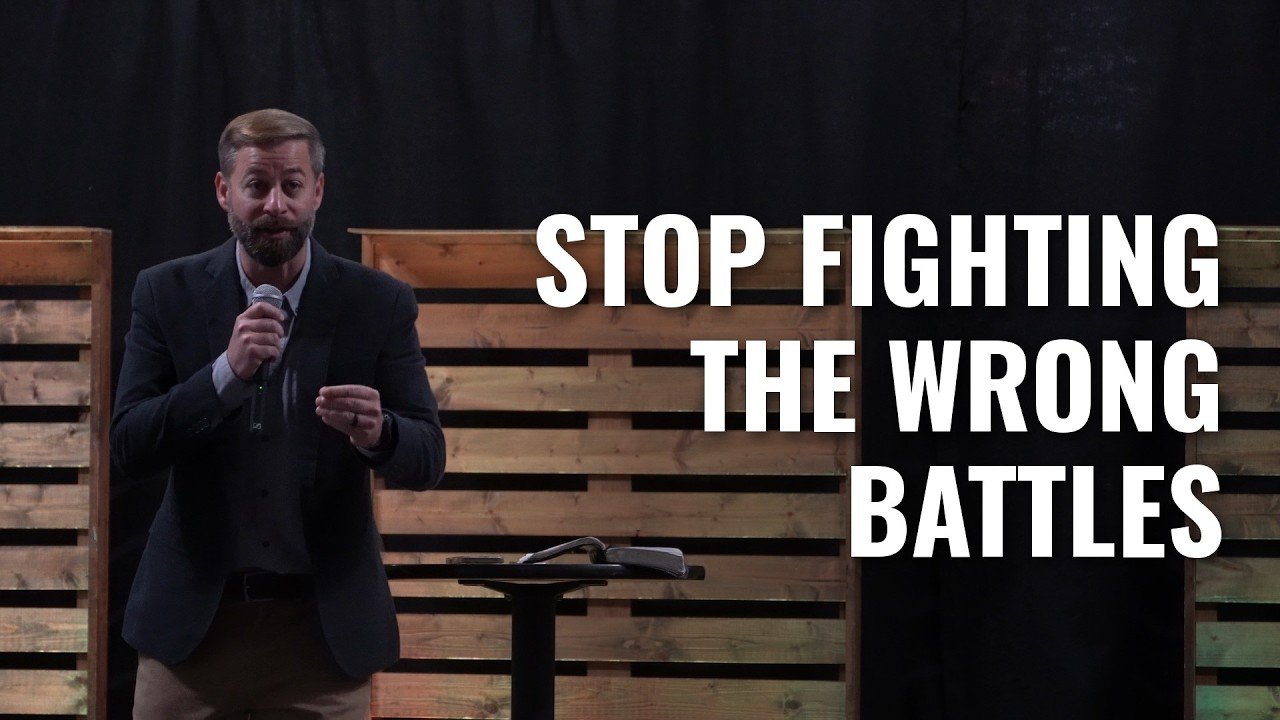
Your Real Fight Is Never With the Person in Front of You
Christian Freedom Series, Week 25
Sheathe your sword until the real battle.
Download the printable discussion guide (PDF)
Summary
Galatians 5:14–6:1 names gentleness as the eighth fruit of the Spirit, and David Hancock, preaching at The Grove Church in Port St. Lucie, Florida, begins where everyone lives: conflict is unavoidable, at home, at work, at the Thanksgiving table, and even in the church. He traces it back to Cain, whose jealousy crouched at the door like a predator, and then further back to the serpent in Eden, the provoker who never fought God but started a fight between God and humanity. Some people run from conflict and some run toward it, but the most destructive figure is the one who sows it from the shadows, as Absalom did at the city gate. The answer comes from another garden. In Gethsemane Jesus tells Peter to put his sword into its sheath, heals the ear of the man Peter wounded, and walks toward the cross, because He is in a greater fight. Gentleness is strength restrained until the real battle arrives. David shows it when he lets Shimei curse and asks his commanders to deal gently with his rebel son, and Christ fulfills it, dying in the place of His enemies to make them friends.
Key Takeaways
- Gentleness, also translated meekness, is not softness, weakness, or the absence of anger; it is strength held back for the good of another, a sword kept in its sheath until the real battle arrives.
- Conflict outside us begins with conflict inside us; the same jealousy that mastered Cain crouches in every person, which is why quarrels follow us into our families, friendships, workplaces, and churches.
- The root of conflict is neither the runner nor the fighter but the provoker, who stands in the shadows looking innocent and sows conflict with gossip, half-truths, and planted shame, the way the serpent did in Eden and Absalom did at the gate; Paul names his work in Galatians 5:26.
- In every conflict there are two ways: rely on yourself, which is relying on the flesh, or depend on the Spirit and receive His wisdom to tell the wrong battles from the right one; walking by the Spirit is the daily habit of depending on Him to animate the gentleness of Christ in you, and it will cost your pride.
Read Galatians 5:14-6:1 (ESV)
For the whole law is fulfilled in one word: “You shall love your neighbor as yourself.” But if you bite and devour one another, watch out that you are not consumed by one another. But I say, walk by the Spirit, and you will not gratify the desires of the flesh. For the desires of the flesh are against the Spirit, and the desires of the Spirit are against the flesh, for these are opposed to each other, to keep you from doing the things you want to do. But if you are led by the Spirit, you are not under the law. Now the works of the flesh are evident: sexual immorality, impurity, sensuality, idolatry, sorcery, enmity, strife, jealousy, fits of anger, rivalries, dissensions, divisions, envy, drunkenness, orgies, and things like these. I warn you, as I warned you before, that those who do such things will not inherit the kingdom of God. But the fruit of the Spirit is love, joy, peace, patience, kindness, goodness, faithfulness, gentleness, self-control; against such things there is no law. And those who belong to Christ Jesus have crucified the flesh with its passions and desires. If we live by the Spirit, let us also keep in step with the Spirit. Let us not become conceited, provoking one another, envying one another. Brothers, if anyone is caught in any transgression, you who are spiritual should restore him in a spirit of gentleness. Keep watch on yourself, lest you too be tempted.
Talk about it
1. When conflict shows up, do you tend to run from it or run toward it? Think of the last argument you were in. What were you really trying to prove, and to whom?
The Provoker in the Shadows: Where Does Conflict Really Come From?
The first story of people outside Eden is a story of conflict. God warned Cain that sin was “crouching at the door” like a predator (Genesis 4:7), but Cain could not master his jealousy, and he killed his brother. There is a bit of Cain in everyone. That is why conflict follows us to the Thanksgiving table, to work, and even into the church: “Is it not this, that your passions are at war within you?” (James 4:1). Paul calls that monster the flesh.
Some people run from conflict and some run toward it. But the root is neither the runner nor the fighter. It is the provoker, standing in the shadows looking innocent, sowing conflict with gossip, half-truths, and a hint of shame that is planted and then denied. Paul names his work: “Let us not become conceited, provoking one another, envying one another” (Galatians 5:26).
THE SERMON’S ILLUSTRATION: ABSALOM AT THE GATE Absalom, King David’s son, wanted his father’s throne, but he did not begin with an army. Every morning he stood by the city gate, where people came looking for justice. When a man arrived with a grievance, Absalom listened and said, “See, your claims are good and right, but there is no man designated by the king to hear you” (2 Samuel 15:3). Then he took the man’s hand and kissed him. No sword and no speech against his father; only sympathy, and a question planted in the ear: does the king really care about you? “So Absalom stole the hearts of the men of Israel” (2 Samuel 15:6). He did not look like the problem. He looked like the hero. Soon a whole nation was at war.
This is where all conflict began. The serpent never fought God. He asked a question, “Did God actually say?” (Genesis 3:1), and started a fight between humanity and God. Proverbs 6:19 says God hates the “one who sows discord among brothers.” The fighter can be seen and the runner can be found, but the provoker hides in the crowd and ruins a community.
Talk about it
2. A provoker rarely looks like the problem; he looks like the one who cares. When have you passed along a half-truth, a “concern,” or a hint about someone and then stepped back looking innocent? What did it give you? Who is the Absalom at your gate right now, and are you listening?
The Sheathed Sword: What Does Gentleness Mean in the Bible?
There was another garden, another provoker, and another kiss. In Gethsemane Judas kissed Jesus to mark Him for arrest. Peter drew his sword and cut off the ear of Malchus, the high priest’s servant. If any fight was ever worth having, surely it was this one. Jesus said, “Put your sword into its sheath” (John 18:11), healed the man’s ear, and left twelve legions of angels sheathed as well. He was in a more meaningful fight.
KEY WORD: GENTLENESS The Greek word Paul uses in Galatians 5:23, prautes, is also translated meekness. It does not mean softness, weakness, or the absence of anger. It is strength held back for the good of another: a sword kept in its sheath until the real battle arrives. Gentleness differs from self-control, the next fruit on Paul’s list. Self-control masters the conflict inside a person; gentleness masters the conflict outside. Jesus described Himself this way: “I am gentle and lowly in heart” (Matthew 11:29). A gentle person is not a pacifist with nothing to fight for, but a soldier who knows which war he is in.
When Absalom took the kingdom, David left Jerusalem on foot. A man named Shimei threw stones and cursed him. David’s nephew offered to take off the man’s head. The king who killed Goliath answered, “Leave him alone, and let him curse” (2 Samuel 16:11). Before the battle he told his commanders, “Deal gently for my sake with the young man Absalom” (2 Samuel 18:5).
Gentleness is to look at your enemy as if he were your son, knowing he has mistaken you for the enemy. Jesus did not want to fight Malchus, the priests, or Rome. He wanted the provoker. “We do not wrestle against flesh and blood” (Ephesians 6:12).
Talk about it
3. Peter was sure this was the fight worth having, and Jesus told him to put the sword away. Where is your sword out right now: in your marriage, with a grown child, at work, online? What would change if you saw the person opposing you as a son or daughter who has mistaken you for the enemy?
Heaven or Hell in a Fight: How Do You Know Which Battles to Walk Away From?
In every conflict there are two ways. 1st: Rely on yourself and you are relying on the flesh; you meet one sword with another, and maybe you win, but you end up standing over someone who looks like a child. 2nd: Depend on the Spirit and you receive His wisdom to tell the wrong battles from the right one. Paul says to “walk by the Spirit” and “keep in step with the Spirit”: the daily habit of depending on the Spirit to animate the gentleness of Christ in you.
The cost is your pride. You will look weak to the world. But the Christian has nothing to prove; he is already a son of God, approved through the work of Christ.
THE PRACTICAL TEST: WHERE TO SHEATHE THE SWORD When you hear gossip and badly want to join in, do not. That is not your fight. If you are the provoking type, come clean and ask for help; a provoker who cannot admit it will ruin churches, workplaces, and his own home. When you see someone else provoking, “restore him in a spirit of gentleness” (Galatians 6:1). Take your sword out, not against the person, but against the evil behind them, and fight with prayer and truth. And at the Thanksgiving table, your war is not politics and not even religion. It is for the person, that they would know you are for them.
Talk about it
4. Gentleness will cost you your pride; you will look weak. Which is yours this week: staying out of gossip, coming clean about conflict you have stirred, or confronting someone in a spirit of gentleness? Who will be at your Thanksgiving table that needs to know you are for them before you say anything else?
The Heart of It: How Did Christ Fight for His Enemies?
David’s conflict was ignited by failures of his own, and ours often is too. But one King walked into a war He had no part in starting. Christ came into a world full of Cains, and the world brought its war on Him.
He was betrayed with a kiss and dragged to a cross. His hands stayed open as the nails went in. He prayed, “Father, forgive them, for they know not what they do” (Luke 23:34). That was His greater battle, to fight for His enemies and make them friends. He fought for you while you fought against Him.
David wept, “O my son Absalom, my son, my son Absalom! Would I had died instead of you” (2 Samuel 18:33). He could not trade places. Christ did. Absalom hung in a tree and was pierced for his own rebellion; Christ hung on the tree and was pierced for ours. On the third day the Father called the gentle warrior out of the grave, and the power of the provoker was put to death.
Talk about it
5. David wished he could die in Absalom’s place; Christ actually did it, for people who were fighting Him. Do you believe God has been gentle with you, or do you still suspect He is against you? If you truly had nothing left to prove, how would you walk into your next conflict?
Questions This Sermon Answers
What does gentleness mean in Galatians 5:23?
Gentleness, the eighth fruit of the Spirit in Galatians 5:23, is strength held back for the good of another. The Greek word, prautes, is also translated meekness. It is not softness, weakness, or the absence of anger. It is a sword kept in its sheath until the real battle arrives, restraint chosen by someone strong enough to do otherwise.
Is gentleness the same as weakness?
No. Biblical gentleness assumes strength; a person with no power to strike is not being gentle by holding back. Jesus could have called twelve legions of angels in Gethsemane and chose not to. David, the king who killed Goliath, let a man curse him and throw stones. Gentleness is power under control, used for someone else’s good.
What is the difference between gentleness and self-control?
Gentleness and self-control sit side by side in Galatians 5:23 but face different directions. Self-control masters the conflict inside you: your own passions, appetites, and anger. Gentleness masters the conflict outside you: how you answer the person who provokes, insults, or opposes you. One governs the war within; the other governs how you carry your strength toward others.
Why is there so much conflict in the church?
Because people bring themselves into the church. James 4:1 says quarrels come from passions at war within us, and Genesis 4:7 pictures sin crouching at the door like a predator. There is a bit of Cain in everyone, so conflict follows us to the Thanksgiving table, to work, and even into the church. Paul calls that monster the flesh.
What does the Bible say about people who stir up conflict?
Scripture treats stirring up conflict as one of the most destructive sins. Proverbs 6:19 says God hates the “one who sows discord among brothers,” and Galatians 5:26 warns against provoking one another. The pattern began with the serpent in Eden, who never fought God but asked a question, and it continues through gossip, half-truths, and planted shame.
Why did Jesus tell Peter to put away his sword?
Jesus told Peter, “Put your sword into its sheath” (John 18:11), because Peter was fighting the wrong battle. Jesus did not want to fight Malchus, the priests, or Rome. He wanted the provoker behind them, and He was in a more meaningful fight. He healed the man Peter wounded and went to the cross to make His enemies friends.
What does Galatians 6:1 mean by restoring someone in a spirit of gentleness?
Galatians 6:1 tells believers to restore a person caught in sin, not to defeat him. A spirit of gentleness means going to him as someone you love who has fallen for the enemy’s lie. The sword comes out, not against the person, but against the evil behind them, fought with prayer and truth, while keeping watch on yourself.
How should Christians handle conflict with family at Thanksgiving?
Remember what the real fight is. At the Thanksgiving table your war is not politics and not even religion. It is for the person, that they would know you are for them and not against them. Sheathe the sword on the argument; gentleness is strength held back for the good of the person in front of you.
Vision for the Christian Life
The Christian life this passage envisions is a people who know which war they are in. They have nothing to prove, because they are already sons and daughters of the King, so they can be insulted without reaching for a sword. They refuse the whisper and starve the gossip, and when a brother falls for the enemy’s lie they go to him in a spirit of gentleness. They look at the one cursing them and see a son. Sheathe your sword. Step into the real fight.
Discussion Questions for Small Groups: Galatians 5
Download the printable discussion guide (PDF)
- When conflict shows up, do you tend to run from it or run toward it? Think of the last argument you were in. What were you really trying to prove, and to whom?
- A provoker rarely looks like the problem; he looks like the one who cares. When have you passed along a half-truth, a “concern,” or a hint about someone and then stepped back looking innocent? What did it give you? Who is the Absalom at your gate right now, and are you listening?
- Peter was sure this was the fight worth having, and Jesus told him to put the sword away. Where is your sword out right now: in your marriage, with a grown child, at work, online? What would change if you saw the person opposing you as a son or daughter who has mistaken you for the enemy?
- Gentleness will cost you your pride; you will look weak. Which is yours this week: staying out of gossip, coming clean about conflict you have stirred, or confronting someone in a spirit of gentleness? Who will be at your Thanksgiving table that needs to know you are for them before you say anything else?
- David wished he could die in Absalom’s place; Christ actually did it, for people who were fighting Him. Do you believe God has been gentle with you, or do you still suspect He is against you? If you truly had nothing left to prove, how would you walk into your next conflict?
Related Messages in This Series
- Faithfulness: How to Hold Up the People You Love Without Going Under
- Goodness: How Bad Are You, and How Good Could You Be?
- Kindness: Why the Best Things in Life Can’t Be Earned and Aren’t Free
Watch or listen anywhere: YouTube | Apple Podcasts | SoundCloud
Pastor David Hancock is the Lead Pastor of The Grove Church in Port St. Lucie, FL, a church where believers and skeptics wrestle honestly with faith and doubt.
Wrestling with a question this raised? You can text in your question on any Sunday and hear it answered after the sermon. Or come sit with people asking the same things. Plan Your Visit
Read the full sermon manuscript
Conflict is unavoidable. In your home, neighborhood, workplace, and even the church. Some run from conflict while others run to it. What’s the right path through conflict? Today we learn when to sheath our swords and when to take them out, because some conflict is meaningless and some must be dealt with. How you handle conflict reveals who and what you are, and which kingdom, heaven or hell, your feet are already planted in.
We are in our series called Christian freedom in Paul’s letter to the Galatians, and today Christ gives us a picture of the warrior who sheathes his sword for the good of humanity. Strength restrained until he faces the true battle. What Paul calls the 8th fruit of the Spirit. The one I’ve been anticipating most. Gentleness. Not weakness, but strength held back for the good of another.
14 For the whole law is fulfilled in one word: "You shall love your neighbor as yourself." 15 But if you bite and devour one another, watch out that you are not consumed by one another. 16 But I say, walk by the Spirit, and you will not gratify the desires of the flesh. 17 For the desires of the flesh are against the Spirit, and the desires of the Spirit are against the flesh, for these are opposed to each other, to keep you from doing the things you want to do. 18 But if you are led by the Spirit, you are not under the law. 19 Now the works of the flesh are evident: sexual immorality, impurity, sensuality, 20 idolatry, sorcery, enmity, strife, jealousy, fits of anger, rivalries, dissensions, divisions, 21 envy, drunkenness, orgies, and things like these. I warn you, as I warned you before, that those who do such things will not inherit the kingdom of God. 22 But the fruit of the Spirit is love, joy, peace, patience, kindness, goodness, faithfulness, 23 gentleness, self-control; against such things there is no law. 24 And those who belong to Christ Jesus have crucified the flesh with its passions and desires. 25 If we live by the Spirit, let us also keep in step with the Spirit. “And those who belong to Christ Jesus have crucified the flesh with its passions and desires. If we live by the Spirit, let us also keep in step with the Spirit. Let us not become conceited, provoking one another, envying one another. Brothers, if anyone is caught in any transgression, you who are spiritual should restore him in a spirit of gentleness. Keep watch on yourself, lest you too be tempted.” (Galatians 5:24–6:1, ESV)
Eventually, no matter what group of people you surround yourself with, conflict is coming. Now, you can avoid people altogether, but soon you will find conflict even with yourself.
The first story of people outside of Eden is a story of conflict.
Cain and Abel both brought a gift or sacrifice to God. God delighted in Abel’s sacrifice, but something was wrong with Cain’s. Perhaps selfishness lay behind it; it is not clear. It was serious, but there was a path through. God met with Him and explained that sin is crouching at the door like a predator, ready to pounce on you. You must master it.
But Cain couldn’t master his jealousy of God’s delight in Abel’s sacrifice. He would rather his brother, like many of us feel about those who are more successful than us, just go away.
So one day in the field Cain struck Abel and killed him.
The terrifying reality is that the same jealousy, envy, and bitterness are in us and ready to pounce, and we must learn to master it. There is a bit of Cain in all of us.
This is why Thanksgiving is famous for conflict. You are bringing together the Cain and Abel of the family. Or perhaps more like Cain and Cain. So when politics comes up and someone says something we think is crazy, our blood boils.
When someone makes fun of your belief with a sly smile, you want to throw gravy at them and slap them across the face with the turkey leg.
But the conflict isn’t just at family gatherings. It’s in our friendships…
Or in the church. I think the problem with the church is that everyone wants a break from conflict, so they put their trust in the idea that they won’t find it in the church. The problem is they have brought themselves into the church, so when we experience conflict here, it’s worse because we didn’t expect it.
Why is it even in the church?
James 4:1-2 “What causes quarrels and what causes fights among you? Is it not this, that your passions are at war within you? You desire and do not have, so you murder. You covet and cannot obtain, so you fight and quarrel.”
The problem isn’t just them; it’s you. A war rages within us. There is a monster knocking at the door, and we answer and let the predator in.
Paul calls this monster the flesh. A conflict is happening in me right now as I preach. There is conflict happening in you as you listen. The monster in you wants to say, what does he know? What does Scripture know about my life? It’s not relevant. Can I even trust it?
Sometimes after a sermon, people say to me, “How did you know I was like that?” How did you know I have those thoughts and struggles? It’s only because I know the evil in me and have spent a lot of time trying to understand it.
There is conflict at Thanksgiving, among your friendships, workplace, and even in the church, because there is already conflict in you.
When you encounter conflict, what do you do?
If you always run from it, you’ll have a hard time keeping your friendships. Often these people hop from church to church. They see something wrong with others, or others see something wrong with them, and then they say something like, “This church is unhealthy, or too judgmental. There is no grace in this church, or there is no holiness.” It’s really an excuse to avoid conflict.
Others love conflict. They break out in fits of anger, biting and devouring for small reasons that only divide the church, workplace, neighborhood or friendship groups. They just want a fight. They push and push until everyone has their swords out.
What’s the root of conflict? Not from the one who runs to conflict or runs from it, it’s someone much worse.
A provoker. The one standing in shadows, looking innocent through it all. This is the worst kind of evil. They stir conflict not by running or fighting, but by sowing it in the shadows. It’s a sneaky kind. Whispering half truths, causing quarrels and fights among you.
They might do it through gossip, turning friends against each other.
They do it with shame. Maybe they hint that something is wrong with you, but when you say it, it sounds like you are saying something is wrong with me; they say, oh no, I didn’t mean it that way, but the thought has been planted.
This kind of provoking is satanic and where all conflict began.
In the garden, a snake, a cunning fallen angel, wise in deceitfulness, looked into the garden and church tradition has said he was jealous of God’s power and God’s love for humanity.
So evil, disguised as a creature that cared for humanity more than God did asked, “Did God really say you would die if you ate? Oh, God is keeping you back, holding you down. If you eat of it, you will be like God.
Humanity, took the bait and ate. Immediately something turned wrong.
God came to look for them, and they hid from God (running from the conflict).
God called them out and asked, what happened? Adam blamed Eve, more conflict, Eve blamed the serpent, and since then, there has been conflict between God and man.
That’s why today, we disobey the one who loves us and knows the best way for us. It’s the same trick that makes us think God isn’t for us.
And then when life goes bad, we blame God.
The devil never fought God, he just started a fight between you and God.
The provoker.
When you find a provoker in the church, among your friends, in the neighborhood or workplace, you must realize this is the most destructive kind of evil.
The fighter can be seen, the runner can be found, but the provoker hides in the crowd and ruins a community.
Satan means adversary; diabolos means slanderer. He is the accuser of the brothers.
James calls provoking wisdom demonic.
In Proverbs 6:19 it says God hates the one who sows discord among brothers.
Why do people do it? It makes them feel alive, significant, involved.
The provoker is usually lonely, and afraid and bored but this gives them some kind of meaning without having to be courageous. It’s drama looking for a stage that makes them look innocent.
In the Bible, Absalom was King David’s son and Absalom wanted his father’s throne.
He didn’t raise an army, at least not a first.
First he got himself a chariot and fifty men to run in front of it, and every morning he stood by the gate of the city, where people come looking for justice. And when a man walked up with a grievance, Absalom stopped him. He asked where he's from, listened to the injustice and then said, "See, your claims are good and right, but there is no man designated by the king to hear you. Oh that I were judge in the land. Then every man with a cause could come to me, and I would give him justice."
And when the man bowed, Absalom reached out, took him by the hand, and kissed him.
No sword. No speech against his father. Just sympathy, and a question planted in the ear: does the king really care about you?
"So Absalom stole the hearts of the men of Israel."
He didn’t look like the problem, he looked like the hero, the one who cared.
But soon, a whole nation would be at war, taking sides between father and son.
How do we stop it when the devil’s way’s show up in our family, community, friendships, and churches? Not how you would think.
There was another garden, Gethsemane. There, Jesus and his disciples were praying. Judas the betrayer, schemed in the shadows and slithered up and kissed Jesus, signaling to the Roman army that this is the Jesus that needs to be arrested. Another kiss from another provoker.
As the soldiers approach, Peter sees the conflict, so he takes out his sword and cuts off the ear of Malcus, the servant of the High Priest. The High Priest was like the chief religious leader.
Jesus said to Peter, “all who take the sword will perish by the sword.”
Then Jesus healed the Malcus’s ear.
Peter has got to be thinking, if ever there was a fight it’s this. An innocent man being arrested, the hero being chained, or as Christians say, God being put to death. If anything should be fought against it’s this.
But Jesus was in a more meaningful fight. Jesus says he could have called down 12 legions of angels instead, he sheathes the angels and says to Peter, " Put your sword into its sheath.
This is what Paul calls gentleness or also often translated as meekness.
Gentleness is to sheath the sword for a greater purpose. Gentleness is recognizing the real fight. The fight under the fight. It’s not softness, weakness, or absence of anger.
It’s not self-control, which is mastering conflict in you, but gentleness is how to master conflict outside of you.
Gentleness sheaths the sword until the real battle is before you.
Imagine an MMA fighter trained to destroy his opponent. He is with his friends at a bar, and a drunk man bumps into him and says, hey, what’s up, man? You pushed me. The MMA fighter could have said, no you fell into me, you’re drunk. But instead tries to de-escalate. “Sorry brother.” The drunk man raises his voice and decides he wants to fight this man, not knowing he is a trained warrior. The MMA fighter decides it’s time to walk away. He has nothing to prove; he could destroy this guy, and for the sake of this guy, he keeps his fists open and walks away. Strength restrained.
Do you see, that often, we escalate conflict because of our pride and insecurities like we have something to prove, but that is the devil’s work, in the shadows causing fights and quarrels. Making you feel shame and the need to prove you are worthy through conflict, and when you feel that shame, sin is crouching.
2 Tim. 2:24-26: correcting with gentleness is how people escape from the snare of the devil. Gentleness undoes the devil’s work.
This is Jesus own words about himself. He says about himself, that He is gentle and lowly.
Jesus’s battle was against the root of all evil. He looked past the conflict before him to the cross, where he would disarm all rulers and principalities of darkness. He didn’t want to fight us, Malcas, the political powers, the religious powers, he wanted the provoker.
Paul says in another book, our war is not against flesh and blood. The man who sheathed his sword is not a pacifist; it’s a soldier who knows the war he is in. The same is true for us. There is a greater battle, so we sheathe the sword for the good of the people in front of us, trying to pick a needless fight against us.
Back to David. The trumpet has sounded, signifying that his own son has stolen the kingdom. David left Jerusalem on foot.
On the road a man named Shimei comes out and starts cursing David and throwing stones at the king. "Get out, get out, you man of blood!" David's nephew Abishai has his hand on his sword: "Let me go over and take off his head."
The king who killed Goliath, who has an army at his back says, "Leave him alone, and let him curse. It may be that the LORD will look on the wrong done to me and repay me with good. Sword sheathed. Verdict handed to God.
Before the two armies of Israel fight David says, "Deal gently for my sake with the young man Absalom."
What’s going on with David? He loves his son.
Joab, one of David’s commanders, doesn't obey David. He finds Absalom hanging, legend says, Absalom was riding his mule and got caught by his beautiful thick hair in a tree and Joab put three javelins through his heart. And when the news reaches David, he weeps: "O my son Absalom, my son, my son Absalom! Would I had died instead of you."
David embodies gentleness and Joab fails to. Gentleness is to look at your enemy as if he were your son, knowing that his battle isn’t with you; he has mistaken you for the enemy.
Do you see how hard this is? It’s to see the people fighting you and seeing them like your son, knowing that they have missed it; they have misread this life.
Now how do we get the ability to do this?
Paul says, if you want the wisdom to know what the true fight is, and walk in the path of the kingdom of heaven, and love people like your son or daughter even as they try and create conflict with you, then you have to learn to walk by the Spirit and keep in step with the Spirit.
To walk in step means you have a habit and keep in step means you are disciplined about that habit. What’s the habit? To depend on the Spirit to animate the life of Christ in you.
Christ calls himself the vine and us the branches, and says without him we can’t bear any fruit of gentleness in our life. So when we depend on the Spirit, the Spirit becomes like the vein that runs from us, to Jesus the divine roots system of gentleness, and the Spirit draws Christ’s gentleness in us so that it is expressed in our lives to have the wisdom to see the true fight and gentleness in whatever conflict is before us.
The choice before in the middle of conflict is the way of heaven or the way of hell.
Conflict is everywhere and when you rely on yourself, you are relying on the flesh which Paul calls a monster in you. So you say to the monster, I’m going to navigate the conflict, and you meet one sword with another sword, and maybe you win, but you stand there over the dead body of someone who looks like a child. You engaged in the wrong battle. This is the work of Satan in your life. Even the MMA fighter could do this by his own effort.
But when you depend on the Spirit, you receive His strength and His wisdom to know how to navigate the conflict before you. You can distinguish between the wrong battles and the right ones and sheath the sword at the right times. This is the Spirit’s work in your life.
The cost is your pride. You will look weak to the world, but the Christian has nothing to prove. They are already a royal son of God, approved by God through the work of Christ.
That was Christ’s greater battle. To fight for His enemies to make them into friends. That was his mission. All of us who have Cain in us.
The reward is over time; you will see others who have been against you see the error of their ways. Not always, but it will happen.
This is the path of the kingdom of God. Walk in by depending on the Spirit.
When you hear gossip and desperately want to join, don’t. That’s not your fight.
If you are the provoking type, come clean to people; come and tell me you need some help.
If you are and can’t admit it, you will ruin churches, workplaces, neighborhoods, and your own home.
When you see others provoking, you must learn to confront with gentleness, as Christ did with you. Take your sword out not against them, but the evil behind them. Go and fight with prayer and truth. Call them out in a spirit of gentleness as Paul says in 6:1.
You love them like a son or daughter, knowing someone you love has fallen for the enemy’s lie.
At the thanksgiving table your war is not politics; it’s not even religion. It’s for the person, for them to know you are for them, not against them; they are like your son. That’s the bigger fight, and once they know you care for them like that, then you are ready to tell them about the one who is truly gentle in heart, Christ.
David’s conflict was ignited by failures of his own. The same is often true with us. But there was one King who walked into a war he had no part in starting.
Christ came into a world of jealousy, envy, infighting, a world that was angry at God for their life turning out how it did. A world full of Cains who can’t master the sin crouching at their door.
And the world brought war upon Him. Betrayed with a kiss in the garden, spit on in his false trial.
Then he was dragged to the cross,
and his hands remained open without the sword as they drove nails into his wrists.
He prayed for his enemies “Father forgive them, they don’t know what they do.”
Then on the cross, He took all the sins of his enemies, the Cain in us and when He died, the Cain in us died with Him.
He fought for you as you fought against Him.
Just as Jesus healed Malchus's ear, so Jesus can give us ears to hear of the God who is gentle with us, who fought for us while we were still His enemies.
The same way David said, "Oh, Absalom, that I would have died in your place." So Jesus says that about us. Only He does.
David couldn’t trade places with Absalom and hang from the tree, but Christ did.
While Absalom hung on a tree and was pierced for his rebellion, Christ hung on the tree and was pierced for ours.
And on the third day the Father called the gentle warrior out of the grave, and through that empty grave the kingdom came.
Through the cross and empty grave the power of the provoker was put to death.
Like Christ, sheath your sword to meaningless conflict, and fight in the spiritual war, in the unseen world, happening all around us. Join me in the real fight.